Inquiry Based Learning – What I Learned

Today wraps up my Inquiry Based Learning class and I can firmly say that I learned far more about Inquiry Based Learning than I realized there was to learn! I thought I had a general understanding of this practice, but I learned that there was so much more to it and there were so many details and important steps needed to create a truly valuable Inquiry Based Learning experience.

The biggest change I experienced as a learner and a teacher during this class is a large amount of new knowledge, ideas, and strategies. I learned so much from the reading and articles that were a part of our weekly content and also so much from my classmates as they posted their ideas, lessons, and units. In my final blog post for my Inquiry Based Learning class, I have reflected on my newly gained understandings and insights.

Inquiry Based Learning…

  • is a dynamic process driven by investigable questions.
  • focuses on students using process skills to learn content.
  • provides opportunity for students to develop process skills which will serve them well in their future studies and employment.
  • can be teacher-directed, teacher-student shared, or student-driven, depending on the activity and circumstances.
  • has essential features including engaging in questions, giving priority to evidence, using evidence to formulate explanations, making connections, and communicating and justifying explanations.
  • can be enhanced by the use of web 2.0 tools to engage, create, and communicate.
  • can be planned well following the 5E instructional model, beginning with the end goal in mind, and helping students connect prior knowledge to new learning.
  • should be assessed with both formative assessments, frequently and during the learning in order to make instructional adjustments, and with summative assessments at the end of the unit.
  • can be effectively assessed with the use of rubrics to assess content and process skills.

two girls doing school works
Photo by Pragyan Bezbaruah on Pexels.com

There are several steps that I have started to take and will be taking in order to provide valuable inquiry learning for my students. The following are my action steps:

  1. Give students a topic and have them start to ASK QUESTIONS! What do they think of? What do they wonder about? What could we explore and learn about related to this topic?
  2. Focus on teaching process skills and provide more opportunities to put process skills to use.
  3. Leave behind the role of instructor more often and give my students more control and say in how we learn about a topic. Give prompts or give some suggestions as needed.
  4. Use the 5E instructional model to plan my units and lessons.
  5. Incorporate and offer additional Web 2.0 tools.
  6. Increase my use of rubrics for assessment of content and process skills.


I have learned that I can bring a lot more inquiry into my classroom which will increase student engagement and knowledge that will more likely be committed to long term memory. It is really important to me that my students care about what they are learning and have the desire to dig deeper and learn more because they are genuinely interested. I believe following the action steps I listed above will help me create a positive, engaging classroom.


silver ipad on table
Photo by PhotoMIX Ltd. on Pexels.com

Inquiry Based Learning Continued – Week 6

This week during my work for my Inquiry Based Learning class I learned about planning lessons according to the 5E Instructional Model and “beginning with the end in mind”. This phrase really caught my attention because it connects with The Leader In Me training that I am learning and teaching to my students. The Leader In Me has seven habits, one of which is that exact phrase; “Begin with the end in mind.” This phrase is applicable to almost any situation where a task needs to be done. I apply this habit in my personal life, with my own children, and in my professional life in my work and with my students. I think this phrase or guideline makes perfect sense when planning a lesson. I see value in considering what I want my students to know, understand, and be able to do at the end of the lesson and/or unit.

girls on desk looking at notebook
Photo by Pixabay on Pexels.com

Another topic of study this week that I found to be particularly informative and helpful was the exploration of Web 2.0 tools. It was especially interesting me to consider and brainstorm their use not only as helpful technology, but more importantly as tools for formative assessment. I really liked reading the ideas of other students because many of them chose Web 2.0 tools that I have either not tried and some that I have not even heard of. As I have learned about this topic this week, I recalled the ways that I use formative assessment in my teaching. I took some time to consider areas where formative assessment is lacking in my instruction. The addition of some more formative assessments could help me make better decisions about my instruction as my classes progress through a unit.

turned on macbook pro
Photo by hitesh choudhary on Pexels.com

As I am moving into the last week of my Inquiry Based Learning class, I see all of the pieces of information coming together.  I am ready to move into the final week of the course and I am proud to have worked hard learning so much about this timely and necessary teaching practice.

Inquiry Based Learning Continued – Week 5

My understanding of inquiry based learning has grown over the last two weeks as I’ve learned more about how to support students in their use of process skills of inquiry as well as their abilities and understandings of the practice. Furthermore, I had the opportunity to take a closer look at many Web 2.0 tools and explore ways in which they support inquiry based learning and enhance discussions and student work. All of these have given me a better picture of what inquiry based learning looks like, and more importantly, how I can implement it effectively in my technology classes.

notes macbook study conference
Photo by Startup Stock Photos on Pexels.com

My decision making skills were tested when we explored facts vs. concepts. The discussions that I took part in opened my eyes to the various methods and reasons for categorizing statements as such. Similarly, I have a deeper understanding of inquiry and how investigable questions play a valuable role in a great inquiry based learning experience. I specifically appreciated the task of turning non-investigable questions into investigable questions as this will be valuable to me in planning my lessons. I actually found it to be easier to make that change than I would have expected. I recognize the importance of students actively engaging in methods for exploring and investigating questions to find answers.

This week my exploration of Web 2.0 tools was really fun. I was really glad that this task was a discussion topic because I learned so much from what my classmates shared. I learned new tools, new ways to use tools, and new ideas of how to implement them to enhance a lesson, not just use them for the sake of using them. I found it interesting to split the tools into presentation, video, mobile, and community tools. It made perfect sense, I just never thought of them in categories like that. This was my new “insight” for the week. It is helpful to consider them in categories because if a specific tool that I use is either no longer available or is no longer meeting my needs, I now have a list of other options to consider.

app business connection device
Photo by Pixabay on Pexels.com

Over the last two weeks, I feel like I have learned more about the details of implementing successful inquiry based learning. I have a “big picture” in my mind now. I’m looking forward to putting together the final pieces as my class continues.

Inquiry Based Learning Continued – Week 3

My understanding of inquiry based learning has continued to develop over the last two weeks of my Inquiry Based Learning class. I have learned a lot about the importance of building a community in the classroom and also about the abilities and understandings necessary to participate in inquiry based learning. I have had the opportunity to examine several case studies of classroom activities for the type of inquiry being practiced and the abilities and understandings that were present.

boy child childhood class
Photo by Pixabay on Pexels.com

A new insight I have developed about Inquiry Based Learning is that not all abilities and understandings will be present, nor need to be, in order for worthwhile inquiry to be happening. Different abilities and understandings will come into play at different times and often several will be practiced simultaneously. As students have more opportunities to participate in inquiry based learning, they will likely apply more and more abilities and skills throughout the process.


Another insight that I have gained is that there is a time and place for student-directed inquiry, teacher-directed inquiry, and teacher-student shared inquiry. I believe that teachers determine which method of inquiry will be best for a particular situation. Circumstances that would drive a teacher’s decision may include the content, the comfort level with inquiry based procedures for students and the teacher, and inquiry based abilities and understandings of the students. As both the students and teacher increase their comfort level and skillsets, I imagine that inquiry activities in that classroom will move on the continuum of inquiry based learning toward being more student-centered. This is something that I now see as a goal for my instruction.


I feel firm in my belief that pertinent process skills and 21st century skills are gained through inquiry based learning. These skills, including but not limited to critical and creative thinking, collaboration, communication, technology skills, productivity, leadership, and initiative skills are all necessities for future success. As I noted in a paper I recently wrote, I believe that these skills will increase productive thinking and contributions and promote an excellent work ethic and leadership whether a student enters the workforce, a trade school, or a university.

adorable blur bookcase books
Photo by Pixabay on Pexels.com

I am still hoping to learn more strategies for implementation and examples of inquiry based learning that are ideal for primary students. I experienced several ah-ha moments this week while viewing examples of inquiry based learning in videos and reading articles about the topic. I would like to continue to view additional real-life examples. I believe this will spark ideas and continue to help me gain a greater understanding of what inquiry based learning can look like in my classroom.

Inquiry Based Learning – Week 1

My understanding of what inquiry based learning looks like has grown during the first week of my Inquiry Based Learning class. I believed it was a teaching practice where students ask questions and explore what they are curious about. There was a lot missing from my understanding of IBL. I didn’t realize the depth of the student questioning and student leading that makes for a true inquiry based learning experience. I also had the idea in my head that it was typically a hands-on activity or exploration and that it was likely mostly implemented in areas of science. I have learned that IBL is not just a science-based approach but can be applied in any subject area.

black and white blackboard business chalkboard
Photo by Pixabay on Pexels.com

Some new insights I have developed about Inquiry Based Learning are the role and prompting of the teacher as well as the connections of IBL and the Scientific Method and the Engineering and Design Process. I have learned that the teacher is still an active part of the learning. He doesn’t simply step aside giving students free rein to explore and maybe even “fend for themselves”. He instead asks questions and joins in the conversation and exploration at specific times in order to elicit further student questioning, and curiosity, and cause students to pursue other avenues of research and/or discussion. Additionally, I found myself recognizing several connections between IBL and the Scientific Process, which I was taught and used through middle school and high school science classes. I also found parallels between IBL and the Engineering and Design Process that my students currently use a guide during our STEM activities and projects. Each of these practices uses questioning, discussion and communication, and collaboration to work toward a common goal which can evolve and grow during the process. My understanding has changed as my knowledge of Inquiry Based Learning has broadened during this week.


Two overall questions that I have as I am beginning this course are “What does this look like in the primary grades?” and “What is the best balance of time spent in inquiry-based learning vs. more traditional instruction?” I look forward to gaining a better understanding of how I can use Inquiry Based Learning with my students in technology class.

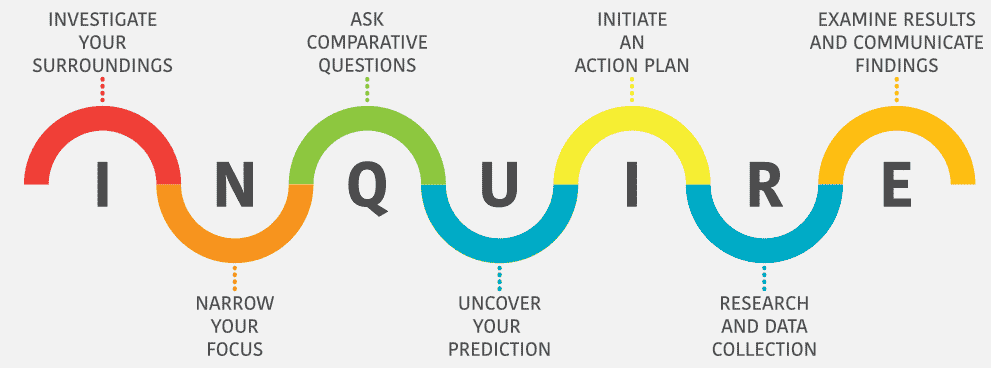
inquire

http://www.iblinstitute.com/